
What you get
Give us one drug name. You get back a finished drug safety signal detection report — a complete assessment in 11 sections, not a surface scan:
The signals
- Signal statistics — ROR and PRR with 95% confidence intervals for every leading event
- Signal flags — the classic Evans criteria applied event by event
- Top-events chart — color-coded by signal strength
- Outcome matrix — death, hospitalization, disability, and life-threatening shares for the ten most common clinical events
- Severity spotlight — serious and death shares for the five most common clinical events
The people
- Who is affected — sex, age group, reporter type, and country
- Events by sex — top events computed separately for women and for men
- Special populations — dedicated pregnancy, pediatric (under 18), and older-adult profiles
- Signals inside the populations — signal statistics computed within each special population
- Pregnancy outcomes — a dedicated breakdown of pregnancy-outcome events
The drug in real use
- Dose, form, route, duration — read record by record from 2,000 recent full reports. No free dashboard does this
- What happened next — action taken with the drug, and whether the event came back on rechallenge
- Dose patterns — parsed daily-dose bands and the sole-suspect share
- Context — concomitant medicines, recorded indications, and the top events inside the leading indication
- Comparator snapshot — benchmarked against two older drugs from the same class
The honesty layer
- Reporting fingerprint — brand-name split, report-type mix, and a litigation flag when lawyer-submitted reports run high
- Trend — yearly trend plus a quarterly view of the last 3 years
- Signal persistence — is the strongest signal still present in recent reporting, or is it history?
- Coverage & limitations matrix — every standard assessment factor listed: included, or named as a limitation with the reason. Nothing is silently dropped
Data: an OpenFDA data analysis of FDA FAERS public data — 26 million+ reports — with the data cut-off date stated on every report. Drugs and biologics only. Vaccines (VAERS) and devices (MAUDE) are out of scope.
Real sample — semaglutide vs tirzepatide
This is a complete, real dossier built from live FDA data on 29 Oct 2026 — not a mock-up. Inside the semaglutide dossier:
- 72,856 reports with semaglutide as primary suspect
- Benchmarked against tirzepatide — 160,201 reports
- Yearly reporting trend and top reaction terms
- ROR/PRR signal statistics with 95% confidence intervals
- Serious-outcome mix and the outcome matrix
- Dose, form, route, and duration read from full records
- Pregnancy, pediatric, and older-adult profiles
- Full coverage-and-limitations matrix
Paid reports follow this exact format for your drug.

Inside a finished dossier: color-coded signal charts, the outcome matrix, and every table labeled with the exact fields it was extracted from.
Why it beats the alternatives
| Option | What you get | What it lacks |
|---|---|---|
| FDA FAERS Dashboard & openFDA | Free raw queries of the same public adverse drug reaction data | No ROR/PRR signal statistics, no interpretation, no finished report |
| Enterprise pharmacovigilance platforms (Oracle Argus, Veeva Vault Safety, ArisGlobal) | Full signal-management suites for pharma safety departments | Enterprise contracts and implementation — priced for companies, not individuals |
| DIY — raw FAERS files + code libraries | Full data access if you can code it | Needs a programmer and a statistician; no finished, readable PDF |
| FAERS Signal Dossier | One finished PDF — the complete 11-section assessment above | Nothing missing for one drug |
How it works
Three steps, kept deliberately plain — the detail lives in the report itself, where every table is labeled with its source.
1. A fresh pull of the public data
- Every dossier is built from the FDA's public FAERS database — the FDA's post-marketing adverse event reporting system — pulled fresh on the generation date printed in the report
- Only reports where your drug is the primary suspect are counted
- Events are grouped in the FDA's standard MedDRA terms
- The 2,000 most recent reports are read in full, record by record — that is what makes the dose, form, duration, and what-happened-next analyses possible
2. Standard signal statistics
- This is drug safety signal detection in its standard form: each leading event is tested with the field's standard disproportionality statistics (ROR and PRR, with 95% confidence intervals) against all other reports in the database
- Events meeting the classic published signal criteria are flagged
- The same statistics are run inside the pregnancy, pediatric, and older-adult groups — and again on recent years only, to check whether a signal is still alive
- Ages, weights, and treatment durations are summarized as medians; dose patterns are read only where a record states them clearly, and quoted verbatim otherwise
3. Charts that match the tables
- The trend chart and the top-events chart are drawn from exactly the same numbers as the tables
- Chart color shows signal-strength tier at a glance
- If a number appears in a chart, it appears in a table — with its source named
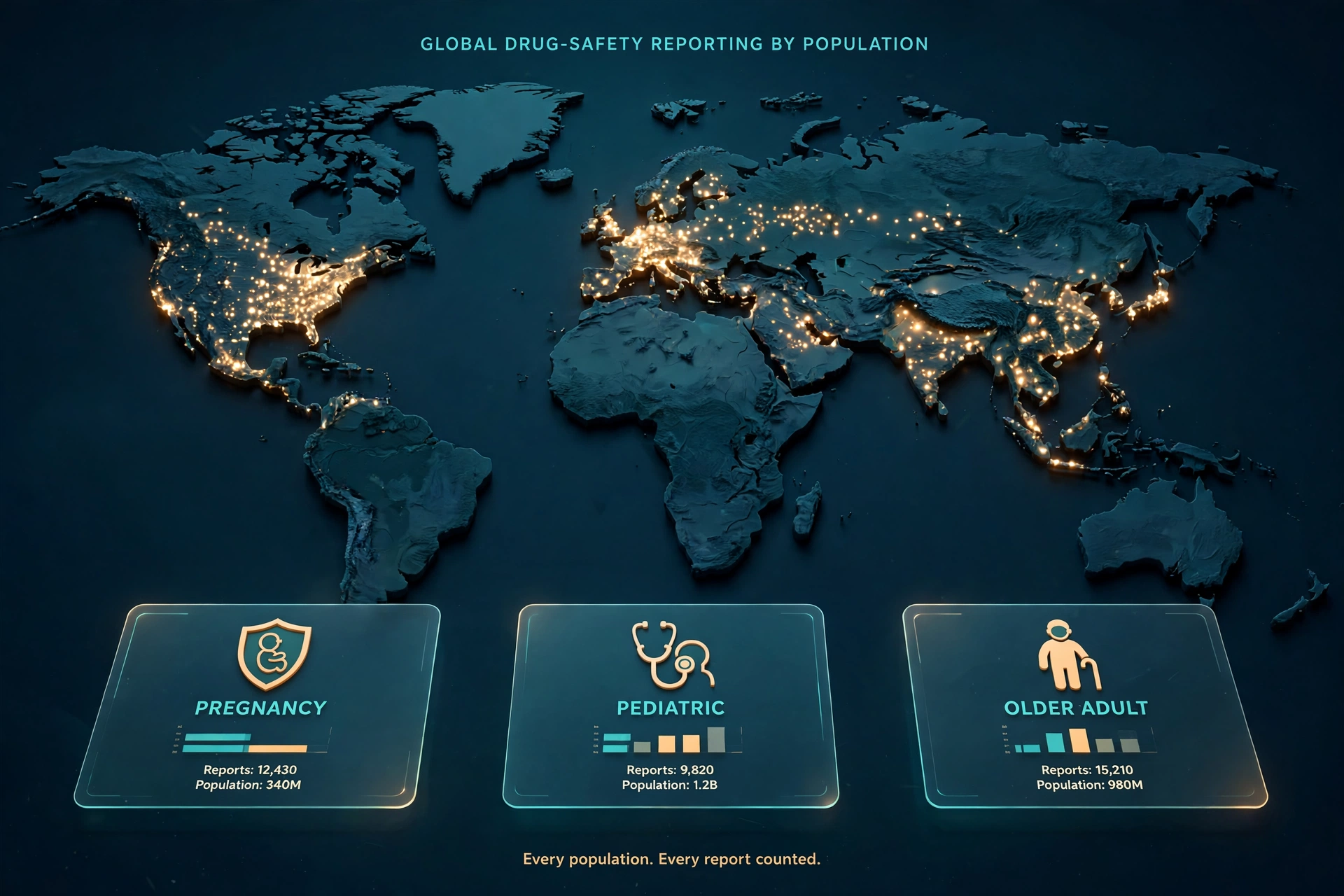
Reporting is global and population-specific: every dossier breaks its drug down by reporter country, sex, age group, and the pregnancy, pediatric, and older-adult subsets.

The review itself: the most recent reports read in full, record by record, until the signal pattern separates from the noise.
Pricing — pay via Stripe
$79 — Single-drug report
Pay $79 via Stripe
$179 — 3-drug bundle
Pay $179 via Stripe
$299 — Up to 5 drugs
Pay $299 via Stripe
A drug adverse event analysis service, not software: no email step — you type your drug name(s) directly into the Stripe checkout form when you pay. Your finished, watermarked PDF is generated from a fresh data pull and delivered on your own delivery page on this site: Stripe redirects you there the moment payment completes, and your View and Download buttons appear as soon as generation finishes. Nothing is emailed to you. Leave the comparator field blank and we automatically select two older drugs from the same FDA pharmacologic class (same mechanism family).
Video walkthrough
What this report is not
Not affiliated with, endorsed by, or sponsored by the U.S. Food and Drug Administration. FAERS data are public FDA data, analyzed independently. A signal does not establish causation. FAERS cannot calculate population incidence because there is no exposure denominator. Reports are hypothesis-generating, not a prescribing recommendation and not investment advice.
Questions
Is this affiliated with the FDA?
No. FAERS Signal Dossier is an independent analysis of public FDA data. It is not affiliated with, endorsed by, or sponsored by the U.S. Food and Drug Administration, and no FDA logos are used.
Does a "signal" mean the drug caused the event?
No. A signal means the event is reported disproportionately often for this drug compared with other drugs in FAERS. It is a hypothesis for further study — FAERS reports are unverified, can be duplicated or incomplete, and rise and fall with media attention and litigation. The dossier says this plainly on page 1 and in its limitations matrix.
Can the report tell me my personal risk of a side effect?
No — and be wary of anyone who claims otherwise. FAERS has no count of how many people took the drug without an event, so no incidence or personal risk can be calculated. That limitation is stated in every report.
What exactly do I receive?
One finished, branded PDF (about 8-10 pages) for your drug: reporting trend and quarterly detail, top events with ROR/PRR signal statistics, serious-outcome shares, the outcome matrix, demographics with sex-stratified events, dose / form / route / duration from 2,000 full records, action-taken and rechallenge tallies, special-population profiles with their own signal statistics, concomitant medicines and indications, a comparator snapshot, and the coverage-and-limitations matrix. Delivery is on your delivery page on this site, right after payment — view it in the browser or download the PDF there.
How long does delivery take?
You enter your drug name(s) in the checkout form when you pay, and Stripe redirects you straight to your delivery page. Generation usually takes a few minutes — a fresh data pull, read record by record — and the page updates itself: your View and Download buttons appear the moment your dossier is ready.
What if my drug has little or no FAERS data?
You are told before delivery and offered a full refund or a substitute drug — see the Refunds page linked in the footer. A thin dossier is never quietly padded.
What happens to my information?
We receive only your email address and the drug name(s) you enter at checkout. FAERS itself is public, de-identified data — no patient information is involved. Your details are used only to deliver and identify your report, are never sold, and a delivery log is kept by the seller. See the Privacy page in the footer.
Do you cover vaccines or medical devices?
No. This product covers drugs and biologics in FAERS. Vaccines are reported to VAERS and devices to MAUDE, which are separate systems and out of scope.
Who it helps
Researchers and medical writers, pharmacovigilance consultants, small pharma and medtech teams, journalists, investors, clinicians, and clinical trial designers — for research, safety review, class-benchmarked context, and future-trial safety planning — a finished pharmacovigilance signal report, without an enterprise platform contract.
Related services
More StarNose services for professionals whose work is judged on evidence:
DossierIQ — O-1A & EB-1A evidence dossiers AI Readiness Audit